
The new generation freighter


The new-generation A350F freighter
CARGO AIRCRAFT
The A350F is the world's only true new-generation large freighter, engineered from the ground up to address the evolving demands of global trade and express cargo. Based on the market-leading A350 platform, it delivers a step-change in operational efficiency, carrying up to 111 tonnes of payload over 4,700 nautical miles.
Featuring the industry's largest main deck cargo door, measuring 4.3 metres wide, the A350F effortlessly accommodates outsized shipments, including large jet engines. Its advanced airframe reduces take-off weight by 78 tonnes compared to competitor aircraft, generating up to 40% lower fuel burn and CO₂ emissions while fully meeting ICAO's latest emissions standards.
The A350F took off to the skies for its first flight on Tuesday 29 September 2026. Explore technical capabilities below or follow the the A350F journey airbus.com.
- New generation
- Most efficient freighter
- Unbeatable commonality


A350F MSN700 First flight - in flight
Shaping the future of airfreight
With unbeatable efficiency in terms of fuel burn, CO₂ emissions* and economics, the A350F is the only freighter capable of meeting the latest ICAO CO₂ emissions standards set for 2027.
By combining advanced aerodynamics, extensive use of weight-saving materials, a unique carbon airframe and powerful Rolls-Royce Trent XWB-97 engines, it achieves remarkable performance. This translates to at least 20% lower fuel burn and CO₂ emissions vs competitor aircraft.
Based on the top-selling all new A350, the A350F can be seamlessly integrated into airline fleets. Airbus is proud to bring the A350F as the only new generation freighter.
*vs the aircraft it is meant to replace.


A350F MSN700 Airbus
A350F: innovation meeting operators' needs
The A350F is a direct reflection of our customers' evolving needs and specific insights from trusted partners in the cargo industry.
Innovation is at the core of the A350F’s design and production. Understanding the demands of modern logistics, we designed the A350F with operators. As a direct response to their needs, the A350F will feature the largest main deck cargo door in its class, allowing quicker loading of diverse goods, keeping global trade moving smoothly. Its optimised fuselage and impressive internal volume will allow that more freight can be carried. A350F's unique floor design optimises flexible pallet loading, enabling better center-of-gravity management and maximizing cargo capacity. It also meets the benchmark flight from Hong Kong to Anchorage – the most often flown cargo route in the world – at full payload.
This makes the A350F perfectly suited for diverse cargo needs, from express parcels to heavy-duty industrial goods like engines.

Explore A350F capabilities

A350F first flight
Explore our new-generation freighter's journey on our dedicated page.
Explore the A350F range


XL Cargo Door
The A350F benefits from the largest main deck cargo door of the industry with a cut out width of 175 inches, and a clear opening of 169.5 inches.
A350F: built on proven A350 Family excellence
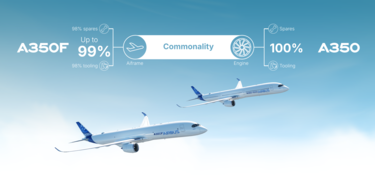
infographic A350F
Building on the proven success and maturity of the A350 passenger aircraft family, the A350F is designed to deliver the same high degree of operational reliability. This exceptional reliability is a critical factor, especially when global supply chains depend on timely deliveries.
Airlines already operating A350s will find significant advantages with the A350F. Flight crews holding an A350 type rating will be able to adapt quickly to the freighter, and ground technicians familiar with the passenger version will find a straightforward transition to maintaining the A350F.
These two models share 100% commonality in engine spares and tooling, allowing airlines to optimise their maintenance operations and reduce inventory costs. With 99% commonality in airframe tools and 98% in spares, the need for additional investment is significantly minimised. This extensive commonality simplifies fleet management and enhances profitability, enabling airlines to make the most of their existing resources while maintaining a streamlined, cost-effective operation across the A350 family.
With millions of flight hours and exceptional operational reliability (99.5% in 2024), the A350 family provides a dependable foundation for this new cargo aircraft.
Key figures
A350F

Capacity
- Payload
- 111 tonnes
- 111 tonnes
- Main deck containers
- 30 containers
- lower deck LD3
- 40 LD3
Dimensions
- Overall length
- 70.80 m
- 232 ft 4 in
- Wingspan (geometric)
- 64.75 m
- 212 ft 5 in
- Overall height
- 17.08 m
- 56 ft 1 in
Download A350F infographic
Infographic
A350F infographic first flight
Infographic A350F Family
Infographic
A350F infographic first flight
Infographic A350F Family
Your A350F questions answered
FAQ
How much cargo will a large freighter like the A350F be able to carry?
Large freighters handle substantial loads. The A350F, for example, is being designed to carry a payload of up to 111 tonnes, which will offer significant volume and enable the transport of heavy and outsize cargo over long distances.
Where can I find the latest news and orders about the A350F?
Check out the latest A350F news, stories, and photos on airbus.com dedicated A350F journey page
What kind of cargo will the A350F be able to carry?
Its large main deck door and high volume will make it extremely versatile. It will be able to efficiently transport a wide range of goods, including time-sensitive express packages, e-commerce shipments, pharmaceuticals, perishables and livestock requiring temperature control, high-value electronics, and even heavy industrial equipment or oversized cargo.
Can the A350F transport live animals?
The A350F can transport live animals like horses, cows, pigs, etc.
Here again the low cabin altitude of 6,000ft will help on the comfort side of animals transported.
What about engine transportation with the A350F?
Examples of engines that the A350F is able to accommodate on its main deck:
PW4168, PW4100, RR Trent 700, CF6-80E1
RR Trent 7000, RR Trent 1000
RR Trent 900 & EA GP7200
CFM56 , IAE2500
CFM LEAP, PW GTF
And in split configuration:
RR Trent XWB
GE90, GE9X
Does the A350F have a crew rest area?
Yes, the A350F has a flight crew rest compartment with one seat and two beds, just like the A350 passenger version, at a 6,000ft cabin altitude.
Does the A350F have a specific air conditioning system?
The A350F air conditioning system has been adapted to segregate air flows of cargo compartments from crew areas to avoid propagation of smells into the cockpit, courier area and crew rest. It also has the capability to lower the temperature down to 4°C.
Is the A350F based on a passenger aircraft?
Yes, it will benefit greatly from the proven technology, reliability, and support network of the successful A350 passenger family, while being specifically designed for cargo operations with features like a large main deck door.
Why are 'next-generation' freighters needed?
With the growth of e-commerce, increasing global trade, and the need to replace older, less efficient aircraft, next-generation freighters will be crucial. The A350F will address these needs by offering significantly lower fuel burn, reduced emissions, and higher capacity, ensuring the air cargo industry will be able to operate more responsibly.
How will modern freighters support decarbonisation?
Modern freighters like the A350F will play a key role. Their high efficiency will mean a lower emissions footprint per tonne of cargo. The A350F is being designed to meet future ICAO CO₂ standards and will operate with lower noise levels. Furthermore, its ability to use Sustainable Aviation Fuels (SAF) will be critical for the industry's decarbonisation pathway.
Discover the rest of the Freighter Family.
Our Aircraft
-
Passenger-to-Freighter
- Airbus supported conversion program
- Airbus Fly‑by‑wire Freighter Family
- Large A330 passenger fleet in service
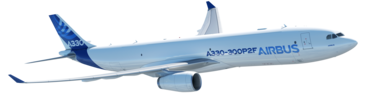
A330-300P2F in flight
-
Passenger‑to‑Freighter
- Airbus supported conversion program
- Airbus Fly‑by‑wire Freighter Family
- Large A330 passenger fleet in service
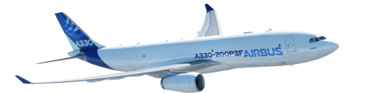
A330-200P2F in flight
-
A versatile and flexible freighter
- Up to 70 tonnes payload
- 96x125in pallets side‑by‑side
- Flexible Cargo Loading System (CLS)
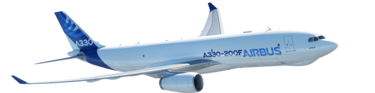
A330-200F in flight
-
Next generation single‑aisle freighter
- Containerised lower‑deck
- +28% volume, +22% payload vs competition
- Best solution in size vs ageing competitor
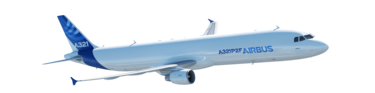
A321P2F in flight
-
Next generation single‑aisle freighter
- 50% more pallet positions
- 6% lower cost per trip
- Airbus cockpit commonality benefits

A320P2F in flight


